Wednesday, August 31, 2005

Telecom GrandMasters Quiz

Harsh Ketkar and Arnab Pal of VIT won the Telecom GrandMasters Quiz organised by Symbiosis Institute of Telecom Management on 5th Aug 2005. Here's what Harsh has to say:

Telecom GrandMasters Quiz was a national level Business quiz, with over 600 participants taking part, corporates and students alike, in the written eliminations round. Five teams were selected; two corporate teams and three student teams. The corporate teams were from Computer Associates, Bangalore; and from Avaya Software, Pune. The other student teams were ICFAI Business School, Hyderabad; and Symbiosis Institute of Management Studies, Pune. Our team from VIT was the only undergraduate and engineering college team.

The questions were mostly easy. Some were repeated, but the easy nature was compensated for by the buzzer and rapid-fire rounds. I'd give it a 6/10 on the toughness level. Plus there was a crossword round, and a gambling round, where you had to play for 10 or 20 points, and lose 5 or 10 for the wrong answer. At least two rounds had negative marking. We fared a bit badly in the logo round, and the B-school blokes were good at that. But the others were okay. We managed to lead all the way through, in the end the difference between us and the number two team narrowed down to 25 points, from a peak of around 50 points.

One more thing: those SITM guys pamper you like as if you are competing for a gold medal at the Olympics. We were kept in a VIP room just before the quiz, served water, and a volunteer took care of our baggage. On stage, there was a bottle of Aquafina, two glasses, and a bowl full of toffees. After the quiz, they had arranged for snacks; chicken sandwiches, pastries (Pineapple and Black Forest), coffee, tea, wafers and cheese sandwiches. One hell of an ego massage!

Harsh Ketkar

Monday, August 29, 2005

SCOE Pinnacle Quiz

Organised by: SCOE Electronics Department.

Results

1st: Puranjay Parchure and Kunal Sawardekar (Fergusson)

2nd: Siddharth Dani and Kunal Thakar (VIT)

3rd: Anupam Akolkar and Abhishek Nagraj (VIT & COEP/PIET)

Also: Kapeesh Saraf and Vineet Bhatawadekar (COEP/PIET), Unknown Team (VIT)

Remarks:

- The quiz was quite decent, more so because it was a fiirst effort for all those involved. However, any goodwill the new SCOE junta might have earned today wassquandered by all the delays and technical snags.

- The finals questions were ok, but the scoring system made it unnecessarily arbit. They had a weird funda that the first two rounds had forty mark questions, the next two sixty mark questions, the next two eighty markers, and the last four had one hundred mark questions. However, the difficulty level never really varied, and we got some real sitters direct in the seventh and eighth rounds, which was chiefly responsible for our victory. Oh, and they had D&P, so you had X per direct answered, and 1/2 X per passed question. The scorers really had a good time inthis quiz.

- There was a wall of secrecy around the elims answers, and they have not yet been disclosed.

- The quiz followed the usual SCOE Electronics Department tradition of having an acrostic for the answers on the elim sheets. However, since the acrostic was the name of Richie Benaud's autobiography, it helped no one.

Thursday, August 11, 2005

Resonance 2005, MESCOE Sports & Entertainment Quiz

11th Aug 2005

Results:
1st: Siddharth Dani & Salil Bijur (VIT)
2nd: Arvind Iyengar & Nitin Satyamurthi (MESCOE)
3rd: Anupam Akolkar & Anand Ayyadurai (VIT)
4th: Abhishek Nagaraj & Kapeesh Saraf (COEP)
Joint 5th: Anirudh Kasbekar & Arnab Pal (VIT), Rahul Phadnis & Mihir Kulkarni (MIT)

Quiz setters: Karan Oberoi

Report: Resonance '05 was the IEEE organised event in MESCOE where the quiz was one of the sub-events. The quiz was a purely 'Sports & Entertainment'. The elims were rather long, with 50 questions, mostly from western entertainment. The elims questions were decent: many original, some were recycled, some lifted straight away, some really obscure.

The finals began with 2 separate infinite rebounds rounds of entertainment and sports each. Anand & Anupam took a lead in the Ent round when Arvind and Nitin caught up in the Sports round. Siddharth and I scored in the connect the pictures round that followed next. The connects were extremely trivial eg. Connect pictures of Austin Powers, a martini, the logo of Aston Martin (with the words) and Timothy Dalton. Ans: James Bond. There were some (Da Vinci Code, Schindler's List) where the answer appeared clearly in the picture clues. For all of them, though the connect could be obtained by 2 clues, the explanation of the other details were given points. The next round was the audio round with buzzers (rather, banging of desks) and the clips being mostly dialogues from movies or voices of sportsmen (Ian Smith, Pat Symcox). The last round was called 'Cryptic', something like the one in Chakravyuh, where a team got to answer subsequent questions on a topic (for increasing points) after the first answer they got.

Some cribs as usual: Improper distribution of half-points is always a volatile issue, and there were plenty of disputes where half-answers and scoring was concerned. The topics in the Cryptic round could have been better. Some of them were Apoorva Agnihotri and pool/billiards championships. There were plenty of Pg. 3 type questions in the entire quiz that required knowledge of ex-girlfriends and love interests of singers, actors and sportsmen. Now this may be a fair topic for some and 1-2 in a quiz are OK. About 10-12 of such questions? I don't think so.

Wednesday, August 03, 2005

My first Parnab Quiz

(Mirrored on my personal blog.

Parnab Mukherjee (you can see a picture here). That one name is guaranteed to make any serious quizzers blood boil. In his many years of conducting quizzes, he has chalked up a reputation for many things. He's been accused of embellishing his resume, lying about his education, unfairly influencing the outcome of quizzes and having a 6-year old alter ego. In fact, as the saying in quizzing circles goes, the "b" in his name (pronounced "Por-nob" in Bengali) should be left out, because his quizzes are so obscene. But all that is hearsay. I am now in a position to give you the dope on Parnabda first hand because today, I have had the infinite pleasure of actually attending a genuine 24-karat Parnab quiz.

When Salil told me that Parnab was conducting the SCIT Business Quiz, I knew I just had to go. Yes, the quiz was in a remote corner of Pune, and that the organisers were charging an obscene 100 bucks per participant*, but how often do you get to see India's best bad quizmaster perform? I found me an equally enthusiastic partner, and after spending a lot of money on petrol and the exorbitant entry fee, we were there. The quiz, as usual started late (I suspect this was Parnab's fault more than the organisers'). Almost an hour after the indicated time, in walked the great man himself. He then proceeded to conduct the elimination round without referring to any notes whatsoever. In fact, the questions were so off-the-top-of-his-head that he asked a volunteer to write them down so that they would remember them when it was time to check the answers. In theory, such paperless quizzing is what makes him (theoretically) great quizmaster. In theory. Communism works, in theory. But I digress. The elims were extremely so-so. Many of the questions were only tenuously related to business. We didn't do very well at all. We calculated we scored 6 out of 25, and there were many teams who said they'd scored 7s and 8s. We reconciled ourselves to watching the finals fromthe audience seats, and partook of a (really good) repast at the SCIT cafeteria.

We got back to the auditorium 15 mintes late, when they were just announcing the qualifiers, and we found that Ganesh and Salil had qualified for the finals. To our great surprise, so had we. We took our seats on stage, and the long (and allegedly false) introduction of the quizmaster began. This time, they left out the bit about him attending Penn State and Princeton (where he studied Econometrics under John Nash, no less). This may be because of the aforementioned schools' unreasonable reluctance to acknowledge their association with Mr. Mukherjee, but we'll let that pass for now. We will let the fact that several other unsubstantiated claims were made pass. We will even let the fact that Parnabda has really long, scary fingernails pass, and get on to the point of this article, the quiz.

The quiz was, in a word, weird. The questions, as in the elims, were asked without reference to any notes. The answers, too, were given without reference to notes. This rather unfortunate coincidence has led to uncomfortable questions about some of Parnabda's facts. However, since many of the questions were on topics that no one present had ever heard of, we were not in a position of actually challenging the great man. The only complaint I have to make about his four normal rounds is that they were either extremely arbitrary or extremely easy.

The two Parnab Special rounds, of course, were a different story. I call them "Parnab Special"s because I am sure no other quizmaster in the world has either the pizaz or the maaz to attempt them. The first of these Parnab Specials was the newspaper round. The gist of the newspaper round is that you get a newspaper, you choose you a page, and Parnab asks you a question that appears on the page. We chose the front page of the newspaper assigned to us (the 9th July issue of The Hindu). Parnab agreed, and began giving us a lot of gas about couriers, Meghdhoot and the Indian Postal Department. Then, changing subjects with aplomb (and leaving us wondering about the necessity of the aforementioned gas) he asked us the name of the two leading characters in Whatchamacallit, a book by Kalidas. Confused by the explanation of the round given us by Parnab, we mumbled some answer. Parnab smiled and told us that the correct anwer, Shiva and someone else. And how did he link it to our assigned newspaper? Very simple. In a obscure corner of our page, was a tiny 2 sq cm ad for Neelkanth Jewellers. And Neelkanth, as any idiot knows, is one of Lord Shiva's names. Simple, no? The outsatnding brilliance of this question left me stunned, and I didn't really listen to the questions asked the others, but my partner assured me that they were equally astounding.

But the showcase round, as in any other Parnab quiz, was the speciality round. Speciality rounds feature in many Indian quizzes, but the twist in Parnab's version is that you can choose a topic of your choice, off the top of your head, and he asks you a question off the top of his. Your topic can be as obscure as you wish, in fact, he encourages obscurity. However, having been warned that Parnab punishes obscurity, I chose the most general topic I could think of, History. On being prodded to narrow my speciality, I chose Western History. He smiled, and asked me the British Prime Minister who preceded Margaret Thatcher. He gave several clues, saying that the man in question was a Tory, an ex-businessman, and a founder of the New Labour tradition that Tony Blair belongs to. I answered James Callaghan, because although his biodata did not correspond with what Parnab gave in his clues (he was a Labour Party member who used to be a civil servant), he was Thatcher's predecessor**, and that was the question. Parnab disagreed, and said that the answer was Edward Heath. Now Heath, although a Tory, was not Thatcher's predecessor as PM. Nor was he ever a businessman. But such is Parnab's amazing stage presence, his supreme self-confidence, and his extreme pig-headedness that I did not attempt to dispute the answer. He went to the other teams, who had chosen such amazing topics as Heinz and Campbell Soup. Parnab rose to the occaison and asked superlative question, which of course we were unable to answer. Afetr this round, the quiz finished (to the great relief of all involved) and to our greta surprise, we finished third. Due to extreme mental anguish, I fail to recall the names of the winners and runners up, but they did well, and I do not grudge them their extra prize money. I was just glad that the ordeal was over, and ran home.

Thus ended my first Parnab quiz. Will I ever attend another, given the opportunity? Of course I will! This was the most entertaining quiz I ever went to. Parnab truly lives up to his reputation of being overconfident, obnoxious, and the best bad quizmaster in India. What a guy!

PS: I have an idea about an interesting meme. I have included links to every previous anti-Parab article I could find. How about, every time anyopne writes about Parnab, they include links to all the previous articles, so that we have all the relevant opinions and evidence in one place? The next person to write about Parnab, please try it out.

* Before I get any hate mail form SCIT junta, I'll just clarify this. The fee was for all ten-twelve events in the fest, and so wasn't all that exorbitant. We felt it was bad because we had to fork out that much for just one event. I'm sure the guys who took part in multiple events found it reasonable.

** See the list of British PMs here.
Tuesday, July 12, 2005

Season Opener 2005-06 aka the July Open Quiz

Results

1st: Niranjan Pedanekar & J. Ramanand
2nd: Gaurav Sabnis & Sudarshan Purohit
3rd: Manish Manke & Nishad Manerikar
4th: Amit Varma & Leslie
5th: Salil Bijur and Anupam Akolkar
6th: Siddharth Natarajan & Siddharth Dani
7th: names not recalled

Not sure if I've got the 5th and 6th places right, and can't recall the names of the team in 7th place - Please let me know if anyone remembers

Organised & Conducted by: B.V. Harish Kumar

Report:

Before beginning the report, we must record that Harish had just about 3 weeks to put this quiz together, so it was quite a commendable effort in the circumstances. A 25 question elims (a little too short) was quite tight, with most teams answering the same questions and not being able to differentiate themselves too much. The result was a 4-way tie for the last 3 spots, which could be split using the inbuild elim tie-breaker but still left us with 2 teams for the last place. An oral round failed to help, so we ended with a 7 team final.

Amit & Leslie began the 40-odd question final with 10 points and the Sids with 5 points, courtesy topping the elims. The first few questions went through with no team being able to take the shine off the ball, so scores were pretty close at the first score-break. It continued that way with a couple of near misses for teams and probably the large number of teams in the finals had a telling effect. With a couple of audio questions going our way, Niranjan and I were able to pull slightly ahead. Leaders till then, Gaurav & Sudarshan stayed in the hunt. Manish & Nishad made a late surge moving ahead of Leslie and Amit who uncharacteristically missed some of the questions. It stayed pretty much that way till the end.

I was happy with the quality of questions - the range was better than at previous quizzes by Harish and some of the trivia was new. There were a couple of bloopers and some whose framing could have been improved. But we give him the benefit of the doubt realising the short notice for preparations :-)

A special note must be made of the Bhamidipati family for sponsoring the prizes and even taking the 7th team addition into their budget. They needn't have but they did - and thanks to them for that. Harish's wife Sirisha is yet another quizzing wife adding the job of keeping scores to her domestic chores, and joins a list of long-suffering spouses/companions of BC quizzers in having to put up with all this nonsense ;-)

We had about 25 teams on Saturday which is good news for the viability of these open quizzes. Sudarshan plans to the next Open quiz (in September) with a more specific theme of "ATES" - All That Entertains Sudarshan.

The previous Open quiz - 2004-05 season ending quiz

Wednesday, July 06, 2005

The July Open Quiz

Details

* Open quiz.
* Flavour : General
* Teams of 2
* No Registration fee
* Date : 9th July (Saturday)
* Time : 1630 hrs
* Venue : Bhageerath,PSPL - behind Domino's Pizza on Senapati Bapat Road
* Conducted by: Harish

Please assemble at the venue by 1630 hrs so that we can start the elims at 1700 hrs.

:: Harish

Monday, June 13, 2005

Maha!Quizzer - Bombay Round


Venue : Sophiya College,Mumbai
Date : 12th June, Sunday.
Time : 10 to 11:30 am
Organizers : Karnataka Quizzing Association (KQA)

Maha!Quizzer was a unique format consisting of 150 written questions to be answered in 1.5 hours at the same time at 5 locations around the country(Bangalore, Chennai, Hyderabad, Trivandrum and Mumbai). There were prizes for local winners and the title of Mahaquizzer was to be bestowed upon the person with the highest score in all 5 cities.

The only problem was that when a quiz is conducted across geographical boundaries care needs to be taken about the scope being truly fair to people from all the places involved. There were many questions which were very south-centric - for eg. we were asked about a certain mountain range you pass while going from trivandrum to bangalore or something like that. Another complaint was the sport. All the questions involved niche sports and their rules. There were no cricket-nostalgia questions or sport questions that did more than scratch the surface. Most questions were like - "this sport involves an arena of 2 x 15 m and is governed by ...."

The high point of the 'quiz' were the hindi film questions. They were really well set. Also lots of questions on literature-arts-architecture-language. Some of these questions were really good but some however bordered on the arbit. Overall a written 'exam' is never fun and KQA needs to come up with a better format if they really want their Mahaquizzer. Maybe take some tips from Siddharth Basu and Co. at UC.

(Also KQA seems to be getting afflicted with the problems of big associations. When you hear the words 'it's a policy decision not to hand out empty elims sheets' you know that something is wrong)

Friday, June 03, 2005

Anand & Vibhendu's Elims classifications

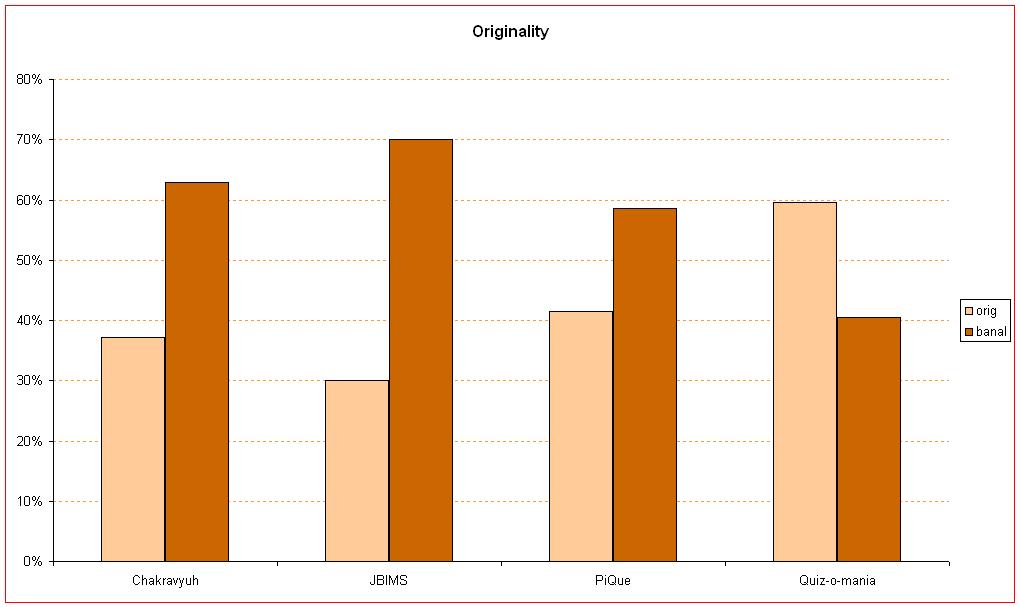
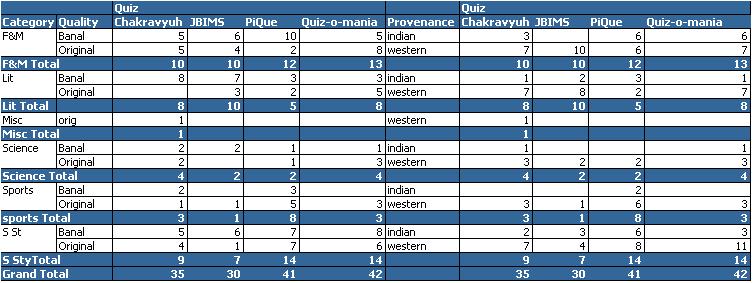
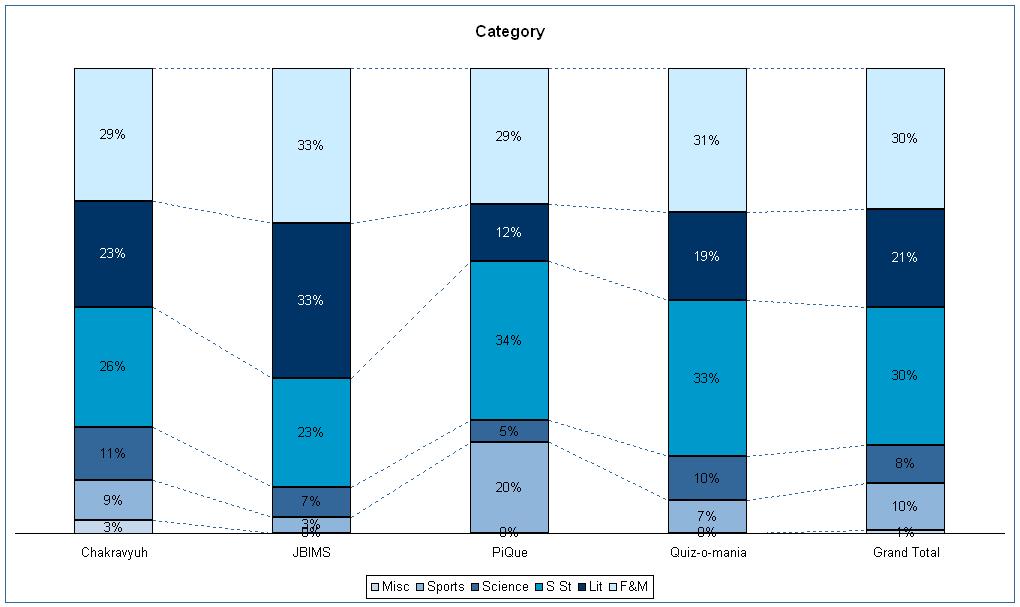
Anand and Vibhendu did some preliminary classification of *Elimination* rounds from four quizzes: Chakravyuuh 2005, JBIMS, PiQue 2005 and Quiz-O-Mania 2005.

After some application of MS Excel pivot chart magic (thus recouping their MBA investments), they have the following graphs to show. The base data is available with me in case anyone's interested. Each image has been preceded by a small note from A & V on how they arrived at those classifications.


Category

[Anand]: Simple [classes], we used a school subject kinda classification consciously trying to nail everything: less on Misc. etc, Social Sc includes History, Geo, Politics, Eco etc and hence appears to have more weightage. (No entry for Yoga, SUPW (Ramanand's note: SUPW stands for "Socially Useful Productive Work" (and has other variations too)))
[Vibhendu]:Mythology, etymology are clubbed under Lit for most cases.


CategoryPosted by Hello

Provenance

[Anand]: Sadly, this is divided into India & Western only--we have left out further subdivisions as that domain belongs to Llosa, Jospin, Chomsky etc--so a Home or Away format.


ProvenancePosted by Hello

Quality/Originality

[Anand]: The criterion used is if we feel it has appeared before in the same form (i.e. worded the same circa John Sutter), or is a basic regurgitation of a standalone fact that has appeared in the same form ( as in the q), or is derived from a fact/incident well chronicled.( This is for Banality)( Like also Lara Croft's stats.) Originality - anything that we felt required the QM to drill down on facts, contort incidents, derives from a reworking of known or even unknown events, and we felt was essentially framed by QM solely for the purposes of asking.( i e the SRT Clapham q, chimes )


QualityPosted by Hello Summary

[Vibhendu]: The classification was done in less than ideal conditions, some of it on our way back from Pune. Hence most of it was done on-the-fly and has not been revisited even once. The exercise is mostly exploratory in nature and was never intended to be a critique of the quizzes, hence no classification on the lines of good, not so good and bad etc. Provenance & category classification was again done to detect any mojor trends in the present day quizzes, can be improved with certain sub-topics institutionalised as independent categories by themselves;-) As for the contentious issue of originality-banality classification, the criterion is here the thought process followed by the question solver rather than the qn-setter. Chestnuts are classified as banal straightaway. Awell known fact making a quizzing debut may still run the risk of being dubbed as banal. e.g, north eastern capitals, new jalpaiguri & Geeta Dutt. Noble intentions behind incorporating quiz-virgin topics, notwithstanding ;-) Again, if the question solver is aided by an existing thread/chestnut, the qn could have been branded banal. e.g. A connect qn on last Male Singles Grand slam winners from the host nations finding an echo in a Ladies singles winners connect.


SummaryPosted by Hello

Regular disclaimers of errors in judgement, subjectivity and lack of consistency follow. Surely, there is enough scope for refining.The reason behind bringing it up was that it can be used as a template/suplement when you do a classification exercise of your own.
:: Anand and Vibhendu


Wednesday, June 01, 2005

On Fairness - Hirak's Blade

After the recent series of posts on the maddening methods, one of our old prabhaaris (the man who almost had the Inquizzition quiz named after him and the orator of the lost Mood-I monologue) Hirak has this to say: (Hirak, pardon me for the usual digs and for including the note before your actual "post" - I included it because I found it relevant)


I was reading the latest series of posts and I think that this discussion is in serious need of Occam's razor. I posted a rather long comment and I have removed it and I request you to post it on my behalf.

You had started a thread about what question setting is all about and that discussion has got subverted on the way. It seems to me that this discussion on systems is quite futile and even if someone does simulate them, the core assumption is that ALL questions will be fair and equal.

Such an assumption can never be made so every simulation suffers from a serious flaw. I, like you, hold a good question very close to my heart and I wish we talk about that more. I also hope that people on notesandstones still believe that quizzing is about fun and learning and not about showing how much you know.

I am currently in stuck in a Third World country (when it comes to quizzing), where quizzing is a rare sport. I am quite jealous of the fact that you guys have enough quizzes to discuss the best quizzing method. Filled with nostalgia here are my two paisa thoughts and a few axioms which which do not seem to be universally agreed anymore.

The discussions have been interesting and the different ideas were refreshingly original. Still, no method has, bar IR, has been tested or simulated. With each correction for unfairness there is an increase in complexity, and hence the chances of adoption of that method decrease.

My hypothesis is: The simplest and best method for fairness will converge to a written final.
It has 'ALL' the elements of a good system:

1) All teams get the same number of attempts.
2) Teams get to attempt every possible question set by the QM.
3) Points in direct proportion to what each team knew.
4) Also takes care of PMQ's and other artifacts of question-framing since everybody is on the same ground.

Of course, despite its technical strengths it is universally rejected because it fails in one vital respect which is 'lack of drama'.

As Kunal noted and which I rephrase as: Quiz Axiom 1: "Quizzes are slightly unfair competitions."

IR is not fair but slightly unfair. A really good system should have the slight unfairness. It is that slight unfairness or element of chance that adds drama and allows a slightly weaker team to win. I still am a proponent of a few buzzer rounds and joker rounds in quizzes.

Quiz Axiom 2: "Quizzing is more about fun than mere regurgitation of facts."

However, fun should not be at the expense of complete unfairness. Most will agree that in essence unfairness has less to do with the 'system' than the kind of questions, and how they are framed. Quizzing should be about the questions and not about the system.

Quiz Axiom 3a: "Quizzers are cribbers"

My chief grouse about quizzes that I lost was there wasn't a balance of topics and some questions were really vague and had no 'Ahaa' value. (Quiz Axiom 3b: You don't complain when you win)

I hope you all agree that we need to talk about content rather than method.

I also believe, that given a reasonably balanced quiz, a good team, regardless of the system, will more often than not finish in the top 3.

Quiz Axiom 4: If you are good, you are good.
OR
You can't fool all the people all the time.

:: Hirak


Friday, May 27, 2005

On Fairness

Quizzes are unfair competitions. In a running race, for example, all the athletes run on the same track, and the fastest among them wins. In golf, all the competitors play on the same course under the same conditions, and the most skilled of them wins. In a quiz, however, each team of finalists is asked a different question each time that other teams may or may not get to answer. Hence, many factors such as the seating of teams, the passing format, bias in question setting, etc skew the outcome in a way that may not reflect the ability of the teams.

Okay, so all of that is old news. Today, stuff like Infinite Rebounds as a passing format and drawing lots for seating are pretty standard in quizzes. However, this is not enough. More is needed. Althought the combination of IR and drawing lots has made quizzes more fair than before, it is felt that we should go further to ensure fairness. So the questions is, what more can be done?

The Centaurian System

The Centaurian System is a passing format derived from Infinite Rebounds which is, IMO based on the assumption that equalising the number of Direct question to each team is essential for fairness. Although I have never really understood how it works, anyone wanting to do so should read this excellent description by it's creator, "Centaurian" Abhishek Nagraj. To the best of my knowledge, no quiz has ever been conducted on the Centaurian system, so no data is available

Criticism: The main Criticism of the Centaurian System is that few accept its central assumption, that the number of directs per team really matter.

Drawing lots for Questions

This method seems to be prevalent outside Pune (correct me if I'm wrong). It basically consists of making chits with every question number on them, and having the teams draw them. The teams are asked the question corresponding the number they pick. The beauty of this systyem is that teams have no one but themselves to blame for the questions they are asked.

Criticism: If your quiz is on Infinite Rebounds and teams draw lots for seating, this procedure is basically redundant. You can draw lots either for seating or for questions, but the quantum of fairness is the same (provided the order of questions is fixed). Its just that drawing lots for seating is easier and takes far less time.

Choice of Seating by Qualfying Order

This method is championed by VIT quizzers since it was first used in Quiz-o-mania '05 the SCIT Software Quiz. The finalists are asked to choose their position in the order of qualification. This means that the team qualifying first will get first pick of seats, the second team will get second and so on. The rationale is that the seating arrangement, while suitably random, allows teams to carry forward to the finals the advantage of their performance in the qualifying round. In other quizzes, teams once in the finals are on an equal footing irrespective of their performance in the elims.

Criticism: This method does not really give the first qualifiers an advantage because they have no say in the seating of other teams. Subsequent teams engage in a competitive game, as all teams jockey to get a favourable position. Even so, the middle teams are likely to get the greatest advantage.

Choice of seating by First Qualifiers

This method calls for the team qualifying first to decide the seating order for all teams. The rationale is the same as the previous method.

Criticism: This method gives an advantage only to the first qualifiers, all other teams being on an equal footing. It also relies on the first qualifiers knowing the capbilities of the other teams. A team from another city, for example would not be able to fully take advantage of it.

Round Reversals

As Abhishek has coverd this in great detail in a previous article, I shall not go into it again. Suffice to say, there should be 0>R>N round reversals, R being the no. of Round Reversals and N being the number of questions (with R preferably being far close to 0 than N).

Post Scipt

I have only ennumerated here the techniques that I have come across. If I missed any, please feel free to point them out.

Monday, May 23, 2005

Round Reversals - Are they really that effective?

I was reading JR's anniversary article archives written in a seemingly alternately illegible hand and experienced firsthand Gaurav's pole-position & 4 quarter system at the S.E.Q. This post is a result of these two things.

The point is this, whatever may be the fallacies in a particular system of scoring these are ironed out due to round reversal. I.e. if a certain team is getting large number of directs due to another team sitting before them, this advantage is immediately transferred to the team on the otherside of that team. So seemingly all is well.

Then comes Quiz-O-mania '05, which witnessed super Vibhendu-Anand first half performance followed by an amazing catch-up in the second half by The Moops. (ala CSKA Moscow). Reason? It was surmised that the first half of questions had a concentration of Hindi-film questions and due to these questions being absent and/or due to round reversal Gaurav's team getting to answer before them they could perform better. So it is like the quiz being in two parts. Two absolutely different styled halves (?) thereby making round reversal ineffective.

So Gaurav decides that we'll go one step further and reverse 3 times. Now as his quiz was mostly done by him and JR (70-30 as he put it) and probably due to dispersion of JR's questions throughout the quiz this didn't have any major difference. I think the result would have been pretty similar had the normal system been adopted.

So does the 'success' of Gaurav's idea as many have claimed mean that the more we reverse the better it is. Actually a good way of testing a particular method is to take it to the hilt and then test it's effectiveness. Funnily it turns out that such a system would effectively result into an 'ox-cart'/Boustrophedon system which JR linked to recently. That is we go along in a particular order and then reverse once the cycle for a question is over.

So consider a particular case.

A - B -C -D. D gets it right. Now it is C's turn by this system. So we go C - B - A - F. F gets it right. Fair enough?

Now consider the following :

Team A : 2 attempts 0 points
Team B : 2 attempts 0 points
Team C : 2 attempts 10 points
Team D : 1 attempts 10 points
Team E : 0 attempts 0 points
Team F : 1 attempts 10 points

Now looking here you would say that logically the next question should be to E. But - as F got it right the next question will go back to A and so on. Those teams, which are around the leading teams, will get maximum number of attempts due to continuos reversals. Now this is an extreme case - but whenever we reverse in a quiz the team that was supposed to get the next question but don't is extremely hard done by. This is like omitting them from the current cycle of questions much like being a lap behind in F1. So whenever we reverse we are heavily discriminating against such teams. Now that I think about it, this happened to us at least once at SEQ. So consider a snapshot of the passing during a reversal: D-E-F-A-F and so on. How unfair to B!

Ideally as most agree 'fair'ness in a system is characterized by equal number of directs and more importantly attempts. So playing around with IR doesn't naturally imply a better system. More importantly I wanted to point out that 'reversal' is not necessarily the answer to all problems. I am not saying that reversals should be done away with - maybe one would be okay. I think next time someone is cataloguing a quiz he could note when the rounds reverse and so on. BTW did anyone manage to track SEQ statistically? That would be very interesting. Pls. post stats if available.

! gnizziuq yppah neht lliT

~ Abhishek

Sunday, May 15, 2005

The Pune Season Ender Quiz 2004-05 14th May 2005

Results:

1st: Niranjan Pednekar (TRDDC) & Sudarshan Purohit (PSPL)
2nd: Amit Varma and Leslie (Wisden Cricifo)
3rd: Rachit Lahoti (GSSL) and Abhinav Sharma (IIM Lucknow)
Joint 4th : Aditya Udas (MESCOE) & Meghashyam Shirodkar, Ganesh Hegde (VIT) & Shivaji Marella (BJMC)
6th: Vivek Venkataramani (BJMC) and Abhishek Nagaraj (COEP)

Organised by: Gaurav Sabnis, J. Ramanand & B.V. Harish Kumar

QM: Gaurav Sabnis

Report:

The Season Ender Quiz (thats the official name) had all what everyone desires in a perfect quiz. The elims had fine audio questions spanning a variety of music genre. The finals were formatted as a basketball game with 4 quarters with a round reversal after each (with no change in positions). The scoring was 2 points for a correct answer and 1 for half, doing away with the usual multiple of 10s scoring pattern. This made the final scores rather close: 20 for the 1st upto 9 for the 6th. A new 'pole position' system was introduced where the 3 toppers top of the elims were rewarded with 3,2,1 points to start.

The top 2 teams that won led the quiz neck-to-neck upto the 1st half of the quiz. Amit & Leslie maintained their lead till the 3rd quarter capitalising on all the cricket questions. Finally in the last quarter, Niranjan & Sudarshan managed a stunning breakthrough by cracking the visual connects on Andrew Lloyd Webber and Savarkar. The unique 'Kekule' connect (with APJ Abdul Kalam at the root node and 5 audio pieces) was particularly the highlight of the quiz. And yes, Gaurav did ask a football related question.

The Pune Quizzing Season of 2004-05 has ended dramatically with one one of the best quizzes we have seen so far. We hope to have a similar great year coming up.

Tuesday, May 03, 2005

Defending quizzing

Samrat's quizzing partner at IIM-L, Tadatmya Vaishnav, has written a couple of posts on the usual arguments against quizzers & quizzing. Here they are:

* In defence of quizzing - I
* In defence of quizzing - II

Friday, April 29, 2005

Pune Quizzing League - Do we have a framework?

[Post by Abhishek]

This is a reworked article about the long simmering idea for a Quizzing League system. I thought I would get the discussion started by putting up a preliminary framework.


Points System

This is the most important part. Points to be considered are:

1. Are points to be given for Elims performances? (even to non-finalists)
2. If yes, then how will they compare to finals points?
3. Generally accepted idea that points scored in finals directly added to total. (?)
4. Are bonus points to be given for 1st 2nd 3rd in Finals/Elims?
5. Resolution of ties?

Following are my suggestions:

1. Elims marks will be considered for all those who have half the cut-off marks. Points = Elims score/Topper x 50. i.e. elims toppers get 50 points.
2. Points in Finals directly added via a percentile system. i.e. winning team gets 100. Rest get score/topper X 100.
3. Since the points are via a percentile system I don't think a bonus giving system is necessary.
4. Finally same points will be given for team members with records being maintained for individuals.


Basic Duties

Following points will have to be taken care of:

1. Drawing up a list of participating quizzes, ensuring their standard, dates etc (one time)
2. Collecting individual scores of participants (repeated)
3. Tabulating scores and documenting results. (repeated)
4. Rating quizzes / Deciding best quiz / Best Quizmaster (necessary?) (repeated)
Logistics

Points to be considered : 1. Is it necessary to have a regulatory body?
2. If yes then how many members, their roles, their number ?
3. If no, then solution to solve the problems of performing 'basic duties' ?

My suggestions:

1. I think it is necessary to have a regulatory body. No of members - 3.
2. Roles -1 Scorer,1 Assessment In-charge. 1 Internet Co-ordinator.

Scorer - Ensuring collection of all the points of the members, Deciding final scoring patterns and settling disputes
Assessment In-charge - Rating quizzes, Ensuring quality etc./ backup for other two
Internet in-charge - Running message board, publicizing monthly updates, sending notices etc.

3. For deciding the best Quiz, QM there will be a general vote at the end of the season whose details can be discussed at a later time.

Other Ideas to Consider

1. A system of relegation of 1 quiz due to low standard and elevation of 1 due to good effort
2. A season ending BCQC organized Quizzing Extravaganza. Maybe a daylong quiz event.
3. Maybe making 'InFest' an official BCQC quiz event, with prizes and teams from other cities.
Finances

1. Is membership free ?
2. Are there monetary rewards for Best Quiz, Best QM , Best Quizzer?
3. Do participating quizzes make any monetary contribution ?
4. If no, then what about finances for season ending quiz and prizes?

My suggestion:

Membership will have a nominal fee of say Rs:50 to discourage floaters. Also participating quizzes will have to give a certain participating fee say 500 Rs. This will ensure some prize money for the 3 prizes. Also for the issue of BCQC quizzing event will have to be organized like any other normal event with funding from sponsors.


In all weaving existing quizzes in to a framework is not as difficult as it seems. It just the cohesive efforts of a group and i think BCQC should take up the mantle of taking Pune Quizzing forward.

:: Abhishek Nagaraj

Tuesday, April 12, 2005

PiQue 2005

I guess most of the day's participants are busy preparing for their exams, so it falls on me to record the results and leave the floor open for reviews.

Results

1st: Kunal Sawardekar & Ganesh Hegde
2nd: Anand Sivashankar & Vibhendu Tiwari
3rd: Niranjan Pedanekar + 1
Also: Salil Bijur & Siddharth Dani, Gaurav Sabnis & Sarika Chuni and Sudarshan Purohit & Srihari Suthamally

Organised by J. Ramanand & other Persistent quizzers

Reports

Got some feedback from Niranjan, Gaurav, Sud, Sarika & Harish. If you have any comments, please use the commenting boxes.

From my part, the disappointing feature was the abbreviated nature of the finals, with barely more questions than in the elims. Also, a few repeats in the elims. Only 4 out of the 44 qns were unanswered with all teams putting on a good show and providing great answers.

Wednesday, April 06, 2005

B.C. Joshi Memorial Quiz and Owl in the Bowl

Army Institute of Technology conducted its annual open quiz Gen. B.C. Joshi Memorial Quiz and its solo quiz Owl-In-The-Bowl on 27th March 2005 in the Persistent Systems Auditorium.

Owl-in-the-Bowl Results:-

1st: Shivaji Marella (Hitchhiker's Guide to the Galaxy)

2nd: Salil Bijur (Life & Works of Jeffrey Archer)

Also: Gaurav Sabnis (PMs of India), J Ramanand (James Bond), Ganesh Hegde (Presidents of USA), Sanket Srivastav (Garfield)

B.C. Joshi Quiz Results:-

1st: Shivaji Marella & Abhishek Nagaraj (BJMC & COEP)

2nd: Kunal Sawardekar & Salil Bijur (FC & VIT)

Joint 3rd: Amit Garde & Hareeth Sridhar (PSPL), J. Ramanand & B.V. Harish Kumar (PSPL & Infosys), Gaurav Sabnis & Sarika Chuni (IBM & Times of India), Meghashyam Shirodkar & Ganesh Hegde (EXL & VIT)

(Apologies for the extreme delay in putting up this post, which was due to the inability of any of the contributors to write a satisfactory report. Since no one has come up with a report yet, we request you to put up your opinions/observations of the quiz in the Blogger comments.)

Tuesday, April 05, 2005

"PiQue" 2005

"PiQue", an open quiz organised by Persistent Systems, Pune

Features:

* General Open quiz
* Two member teams
* No restrictions on age or affiliation
* Venue: Dewang Mehta Auditorium, Bhageerath, Persistent Systems Pvt. Ltd.
* Date & Reporting Time: 10:30 am on Saturday, 9th of April, 2005
* Contact: 25678900 ext 2366 (Ramanand), 25653900 ext 3517 (Amit Garde)
* No registration fees
* Prizes for all finalists
* Audience Prizes

Directions to Venue:

"Bhageerath" is the corporate headquarters of Persistent. It is situated on Senapati Bapat Road, next to the under-construction ICC Towers and Sigma House, and behind (the road-facing) Domino's Pizza
URL: http://www.persistent.co.in/

Saturday, March 26, 2005

Prahelika: The Quiz at PICT Concepts

Set By: Nikhil Kundargi and Neel Mehta

Results:

1st: J Ramanand & BV Harish Kumar (PSPL & Infosys)

2nd: Siddharth Dani & Kunal Sawardekar (VIT & FC)

3rd: Gaurav Sabnis & Sarika Chuni (IBM & Times of India)

Also: Salil Bijur & Ganesh Hegde (VIT), Meghashyam Shirodkar & Aniruddha Kasbekar (EXL & VIT), Arvind Iyengar and Aditya Pethe (MESCOE)


Remarks:

- The questions in this quiz, though good were quite easy. Also, some of them were not original. The elims were very high scoring, with the top qualifiers getting an astronomical 31/42, which shows you how easy the quiz was.

- There were a numner of technical Snafus, including the fact that one visual connect had the answers on the slide itself.

- There was a bit of controversy involving the name of Geriatrix's wife (the QMs said it wasn't ever revealed and someone said it was revealed to be Myopia in "The Secret Weapon"). However, the QMs stood fast, and research by your correspondent has proved them right (insofar as the name does not occur in "Secret Weapon", at least). We await comments by more dedicated Asterix readers on this one.

Wednesday, March 23, 2005

MIT Intechsication Quiz

Organised by: Ruman Tambe & Kedar Toraskar


Results:

1st: Kunal Thakar & Siddharth Dani (VIT)

2nd: Kunal Sawardekar & Ulka Athale (FC)

3rd: Salil Bijur & Ganesh Hegde (VIT)

Also: Anupam Akolkar and Aniruddha Kasbekar (VIT), MIT Alandi, Srinivas Kulkarni & Aditya Pethe (MESCOE)


Remarks:


-The quiz was universally acknowledged as the best MIT Quiz ever. That's not saying much, but it must be said.

-There was an inexplicable preponderance of Astronomy and Astrology questions. About 1/5th of all questions were star-based.

-The quiz featured what is easily the most amazing question I have ever heard in a Pune quiz (I would have said any quiz, but how can you compete with Mood-I?).

Q: Connect Evelyn Waugh and Elvis Presley.

A: They both died in the bathroom.

-Although it did not live up to the expectations of the Quizzing Elite, I think the organisers deserve to be commended for a decent first attempt at setting a quiz.

Tuesday, March 22, 2005

Pragya - The quiz in Rennaissance at Bharati Vidyapeeth

This quiz will be right up there in the Hall Of Quizzing Disasters. We got some premonitions of what was awaiting us when the elimination paper had MCQs with gems such as "Where was the FICCI annual meeting held this year?"
a)Calcutta b) Madras c) Bombay d) Ahmedabad

I had teamed up with Anirudh Kasbekar and we got a call at ten PM saying that we had qualified. On reaching the venue, we found out that Dani and Ganesh's team hadn't qualified. They are the India specialists and their performance was definitely better than ours. In fact, no VIT team had qualified. We had written our college name as only PICT, although Anirudh hails from VIT. Maybe that was the reason we got through. A new innovation at the quiz was the selection of FIVE teams. The quizmasters seem to be devout numerologists. The teams were from PICT/VIT, MESCOE, 2 BVP and AFMC.

The first round progressed well. The next one was a buzzer audio, video round. The buzzers were the most technologically advanced ones available in the neighborhood sarkari office. Just push the plunger and it goes ting-tong. The priority resolution? No problemo. They had trained audio experts who had finely honed auditory powers that enabled them to decide who pressed first. Curiously, those who pressed with greater gusto seemed to prevail over those who pressed first. Over buzzer was the latest model where they had done away wit the tumblers also. It had a hole wherein you had to insert an old marker pen and press it down for it to buzz. When the auditory expert's decision seemed to consistently go against the AFMC team, they got irked and stormed to the well and were somehow placated. The next question, they and an other team pressed the buzzer simultaneously. And, the AFMC team, having blundered in thinking they had ringed first, blurted out the answer. The quizmaster was furious at this blasphemy and fined the AFMC guys TEN points. Their shell-shocked expressions would have provided them practice on how to react in the battlefield when shrapnel are flying all around them. The guy manning the computer had the habit of playing a new audio question without intimating us. This led to some teams (including us) thinking that the previous question was been played fully and not the next ones. Many times, we were jolted into reality only when the BVP buzzers rang out all around. The next blooper occurred at the end, when there was a tie for both the first and third places. The teams from MESCOE and BVP decided to play it safe and forgo the tiebreaker. The organizers initially agreed. Then they declared that the first prize will be shared by the two teams and the second prize and third prizes will go to the other two teams. Soon, we realized that the second placed team would get more than the winning teams. This was not at all what they wanted. The teams tied for the first place protested vigorously and the tiebreakers took place. The question in the tiebreaker was "Who was the second Prime minister of India." The winning team answered correctly but the QM was adamant that they were wrong. Then, he declared the President's name. Unfortunately, he named the second Prime minister of India. The question was scrapped after five minutes of passionate debate. Then was the turn of the AFMC and BVP playoff for the third place. The QM read "How many centuries did SRT score in…." and AFMC pressed the buzzer. The QM stopped midway and looked at them with an expectant and gloating face. Flabbergasted, AFMC requested that he complete the question. They were not heeded and had to answer. They said '34'. With a positively mirthful expression, the QM answered. "Wrong. I meant in International matches. And the answer is 31." I still have a nagging suspicion that if the QM had receive 31 as an answer, he would still have given it wrong and revealed gloatingly that he had wanted the no of total centuries. All in all, this was a quiz that will linger in my memory for a long time to come.

p.s The audience consisted of all eight people while there were six organizers on stage.

Nikhil Kundargi